


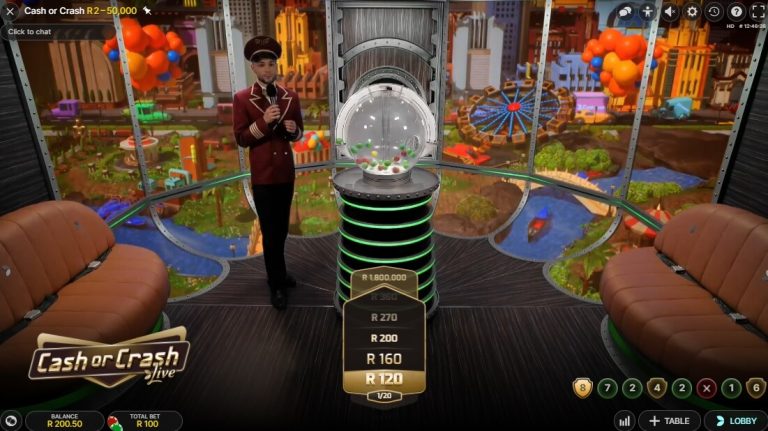
cash or crash live online gambling creates its own niche in the realm of live game shows. Its charm lies in a strong combination of studio spectacle and game design that turns every round into a personal test of nerve. This is not just a spin of a roulette table. Here, you are in the pilot’s seat, making active choices that influence your payout. The premise captivates you with a climbing multiplier, then dares you to grab it before a hidden “crash” clears the board. To maximize your experience, you must ignore the glitz and understand its actual mechanics. Let’s analyze the rounds, the host’s function, the math behind the risk, and how players can practically navigate the thrills.
The Main Goal and Core Mechanics
The objective of Cash or Crash Live is simple on the appearance. You must choose when to withdraw a growing multiplier before a hidden “crash point” ends the round and takes your earnings for that level. All game commences with players placing bets. A rocket then begins its ascent, and a multiplier commences climbing from 1x. The journey has various stages. Prior to launch, a random crash multiplier is determined for every stage, concealed from nobody. As the number climbs, every player decides to hit “Cash Out,” fixing that multiplier on their stake, or to remain. If the rocket hits the hidden crash point ahead of a player exits, they surrender their bet for that round. The pattern of danger and gain repeats over multiple rounds. Players who survive build their earnings gradually.
Dissecting the Stage Structure
Consider the game as a series of separate chapters, every one a new bet. Staying alive doesn’t eliminate you. You proceed to the subsequent stage with your accumulated winnings safe, then commence the risk cycle all over again on the next leg of the rocket’s journey. This framework is paramount. It generates a story, with tension that mounts as you progress. The announcer amplifies the drama, announcing how many players are still staying on the rocket as the multiplier reaches scary values. First rounds often involve safe plays. Advanced rounds, with their big-winning multipliers, tempt you to bet the winnings you’ve already secured. This segmentation is the essence of the game’s excitement. It forces a sequence of separate, stressful decisions instead of just one.
From Green to Red: The Escalating Risk
Pay attention to the color-coded path the rocket travels. It’s a key part of the game’s vocabulary. The initial section is often a “Green Zone,” a lower-risk phase where a crash is still possible. Then, the rocket might reach an “Amber Zone,” a obvious warning that danger is growing. The last segment is the “Red Zone.” Here, multipliers are their best, but the likelihood of a crash is mathematically at its maximum. Such visual cues are more than decoration. They give you a quick visual for the risk level at each instant. They make an intangible probability seem tangible. Knowing the game is purposely alerting you about increasing uncertainty is a critical piece of game strategy.
Statistical Underpinnings and Variance
Let’s look at the figures that drive the game. The crash multiplier for each level comes from a fixed probability distribution. Frequent, small multipliers for instance 1.2x or 1.5x have a high chance of being selected. Extremely high multipliers can occur, but they are exponentially more rare. This system maintains the game balanced. The common, minor crashes pay for the occasional, large potential wins. The player payout percentage is a theoretical percentage across millions of rounds. In a single gaming session, the swings are dramatic. You aren’t betting against the house in a traditional way. You are making decisions against a hidden, random number. Remember these points:
- Isolated Stages: Each level’s crash value is a separate event. A crash of 1.2x in round one gives no info about round two.
- No Predictive Patterns: The RNG eliminates any predictable patterns. Historical crashes or big wins do not influence what comes next.
- House Advantage: The system incorporates a house advantage, which is evident in the provider’s published RTP.
The purpose of the on-air host and RNG

The live host does more than talk. They determine the game’s emotional pace. While they have no impact on the result, they expertly build suspense. They call out the climbing multiplier and give live updates on what percentage of the crowd is cashing out at each level. That social cue can play tricks on your head. But remember, the host is separate from the game’s engine: the Random Number Generator (RNG). The crash point for each stage is set by a certified RNG the instant the stage begins. This guarantees fairness and total unpredictability. The host has no clue when the crash will happen. Their job is entertainment. The RNG’s job is certifiable fairness. This combination merges transparent live action with provably random results.
Methodological Structures and Player Psychology
No strategy can beat the fundamental randomness. But you can apply systematic techniques to handle your money and your mental state. The key trade-off is a compromise. Do you guarantee fixed returns, or pursue massive gains? Users often adopt methods like the “Fixed Cash-Out.” Here, you decide ahead of time to withdraw at a particular multiplier, say 2x, in every phase. This seeks consistent, small wins. The contrary is the “Let It Ride” approach, where you gamble several rounds for a opportunity for a massive win, accepting that failures will take place. A more calculated tactic is the “Percentage Bankroll” system, where you adjust your stake based on your current winnings. The most important element, though, is in your mind. Can you resist the “greed factor” when the multiplier climbs? Can you escape annoyance after an initial failure? Your greatest asset is establishing firm guidelines for yourself before the session even starts.
Typical Mistakes to Evade
Be wary of a few typical blunders. The most damaging is “chasing” a failure. This signifies impulsively boosting your stake after a setback, which contradicts the game’s stage-independent structure. Another error is trusting the “hot hand” misconception, thinking a sequence of big payouts is likely to persist. Permitting the commentator’s banter or the moves of other participants distract you from your own predetermined strategy is frequent. Also, don’t misread the areas. The Amber and Red Zones are not tests to overcome. They are alerts that the hazard has jumped. Going into any round without a defined objective turns the game from a process of judgment into a complete emotional journey. That journey hardly ever concludes favorably.
Conclusion: A Symphony of Fortune and Selection
Cash or Crash Live is a fascinating fusion of pure luck and deliberate choice. Its mechanics are built to craft a tale of escalating tension, fueled by a transparent RNG and animated by a charismatic host. Determining success as a fun and likely rewarding round relies on several factors. It’s less concerned with forecasting the random and rather about grasping how the game is constructed. It requires managing your money with self-control and controlling the mental urges the game expertly triggers. By mastering its phases, respecting its statistical basis, and sticking to a custom strategy, you can change your perspective. You go from confused guesswork to informed involvement in a remarkably thrilling live game show.
